

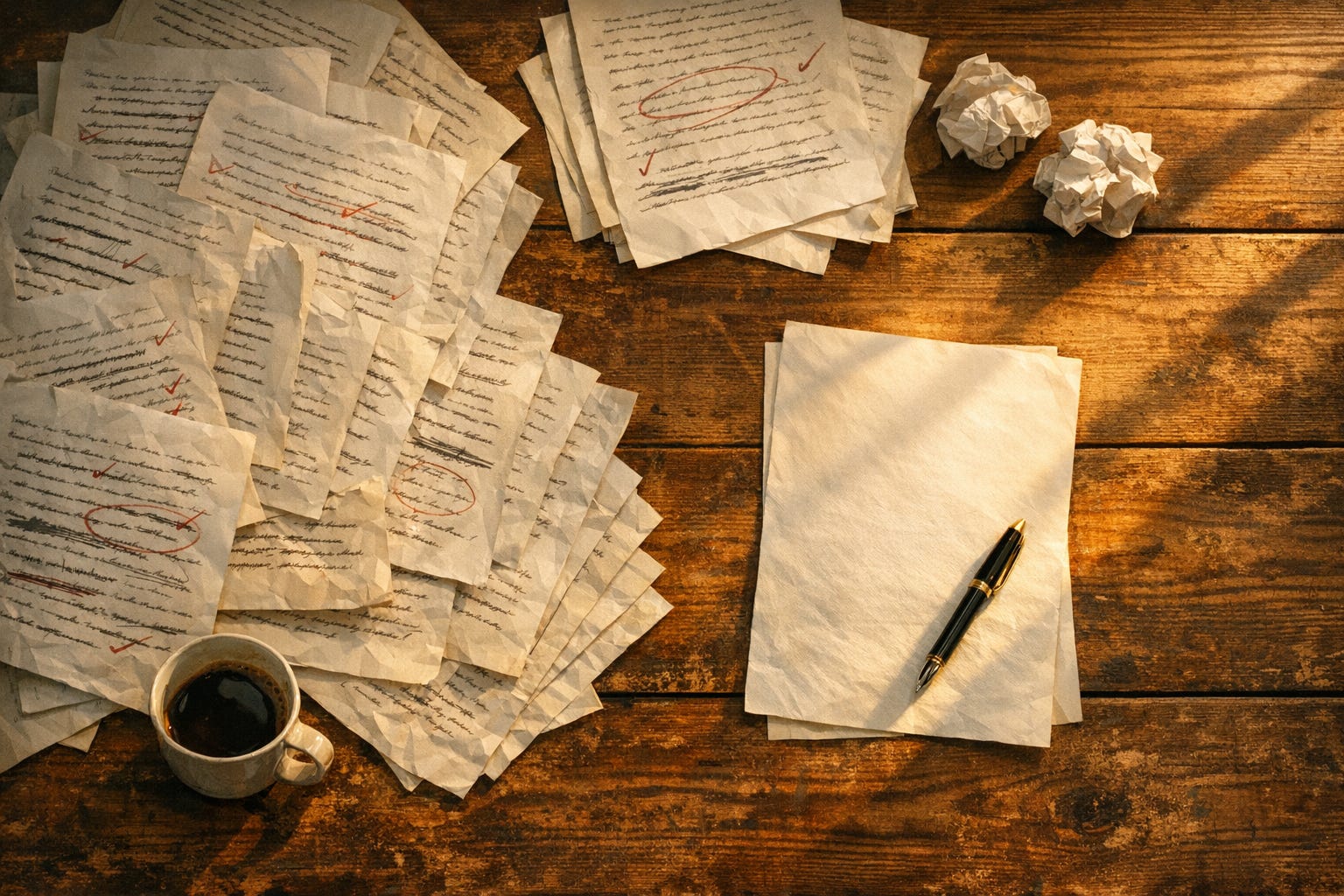
The more I write, the more unpublished drafts I seem to have.
A few years ago, I might have taken that as a bad sign. Maybe I was getting worse at finishing, more hesitant, overthinking things. Now I think it means something else. I think my taste has improved.
Earlier in my writing life, many of these drafts would have been published. Not because they were better. They would have been published because I was too precious about my ideas. I was in love with all of them. Every draft felt like a big insight, something the world needed to hear. And I think that was fine for the time - you’re supposed to be excited about what you make. But the reason everything felt publishable was that I didn’t yet have the discernment to know that some of those drafts weren’t quite there, or weren’t really my thing. They had energy. Some had decent ideas. But now I can feel the difference between a draft that contains something promising and a piece that has actually arrived.
I should be honest: a growing pile of unpublished drafts could also be a sign of perfectionism, or fear, or just overthinking. I know people who hoard drafts because they’re terrified of publishing, not because they’re being selective. But that’s not what I’m describing. What I’m describing is a shift in judgment. Earlier, everything that crossed a basic quality threshold felt publishable. Now, many things cross that threshold and I still feel like they’re not ready, or not mine, or not the thing I actually want to say. That’s a different problem than fear. That’s taste.
And when I say taste, I don’t just mean the ability to tell good from bad. That’s too simple. Most people can already tell when something is obviously bad. What I mean is something more specific: the ability to choose among good things. Something can be well-crafted and still not belong in your work. An idea can be sharp and still not be your point. You can look at multiple interesting, defensible, well-made options and say: this one. This is the one that is mine.
That matters because a lot of creative life is not spent sorting obvious trash from obvious gold. A lot of it is spent among things that are all pretty good. You read smart people. You hear strong arguments. You encounter framings that genuinely have something to them. Spotting quality is rarely the hard part. Deciding what belongs with you is.
Creating more helps with that because creating forces selection.
In your head, lots of ideas can feel promising at once. They can coexist in a kind of flattering blur. You can be excited by all of them. You can imagine all of them going somewhere. But the moment you try to make something, the blur starts to break. Writing forces shape, sequence, emphasis. It forces you to decide what this piece is actually about, which means deciding what stays outside the frame.
That is where taste gets built. In the choosing.
It gets built when you try to express a thought and realise it is thinner than it felt in your head. It gets built when you write a paragraph that sounds fine but has no life in it, or when you notice that a sentence is polished but somehow not you. You feel it when you cut something good because the piece gets stronger without it. You feel it when you let a draft sit because something is there but hasn’t fully arrived yet.
And you don’t need to publish for this process to begin. Publishing sharpens taste faster because the work meets the world - you get response, indifference, resonance, misunderstanding. But even private writing helps. The moment an idea leaves your head and takes form on a page, it becomes easier to judge honestly. Inside your mind, an idea can feel deep just because it’s unfinished. Once you write it down, you find out whether it actually has shape.
Over time, all of these small decisions teach you something deeper than technique. They teach you what kind of work you are trying to make. And that is about voice.
People talk about finding your voice as though it is hidden somewhere inside you, fully formed, waiting for the right moment to emerge. In practice, voice becomes clearer through use. You learn it by trying to say things and noticing what lands and what feels forced. You learn it by hearing yourself on the page and recognising when you are close and when you are not.
Before you’ve made a lot of things, it’s easy to mistake a self-image for a voice. You have a vague idea of the kind of writer or creator you want to be. But that’s not the same as knowing what your work sounds like when it is actually yours. You find that out by making things, by choosing again and again what stays and what goes, by noticing what keeps pulling you back, what kinds of observations feel natural in your hands, what kind of good you want to stand behind.
Ira Glass has a famous quote about the gap between taste and ability - how beginners have good taste but lack the skill to match it. That’s true, but I think there’s another dimension. Your taste itself changes. It moves from a broad sense of quality to a more personal, specific sense of what is yours. That shift doesn’t happen through volume alone. It happens through the repeated act of choosing.
I notice this most when I’m deep in research.
When I write now, I spend a lot of time reading around a subject. I find many worthwhile perspectives, and a lot of those ideas are genuinely strong. The problem is not quality. The problem is that without enough taste, you become too available to every good idea you encounter. Too easily impressed. You start wanting to bring everything with you, to fit every compelling observation into one piece.
That doesn’t make the piece richer. It usually makes it weaker. The writing gets crowded. The centre disappears. The piece begins to sound like a collection of things you admired rather than a coherent expression of something you believe. It may still sound intelligent, but it loses force because it hasn’t chosen what it is really there to say.
Creating more helps you grow out of that impressionability. It teaches you that a good idea is not automatically your idea, that admiration is not direction. You begin to feel, with more confidence, that some ideas are worth keeping close, some belong in another piece, some need more time to mature, and some are simply not yours to carry. That selectivity improves the work because quality depends as much on what you exclude as what you include.
Now, creating isn’t the only way to build taste. Intentional consumption matters too - reading deeply, studying what you admire, paying close attention to why certain things work. But creating has a structural advantage. You can consume passively. You can read heavy, intellectually serious material and absorb the surface without really engaging. You can finish a brilliant essay and feel smarter without having wrestled with any of the ideas in it. Creating doesn’t allow that. The moment you try to make something, you’re forced into engagement. You have to choose, commit, express, evaluate. That’s why I keep coming back to creation as the stronger path, even though intentional consumption also helps.
This matters even more now because good has become cheaper.
Taste has always been valuable. The people whose work you remember have always been set apart not only by skill but by sensibility - by point of view, by a certain flavour that is unmistakably theirs. What has changed is how visible that is as a differentiator. When competence was harder to attain, competence itself did a lot of the separating. If you could produce something good, that already set you apart. Now that polished, competent output is more accessible than ever, taste stands out more clearly for what it has always been.
AI makes this easy to see. It can produce writing, design, and analysis that is clean, competent, and often impressive. And it will keep getting better. The question is not whether AI can produce good work, or even tasteful work. It increasingly can. The question is whether you have enough taste of your own to know what is yours among the options it gives you.
That distinction resolved a tension I had been feeling.
I spend a lot of time encouraging people to use AI more. I teach people how to work with it. I think it is an extraordinary tool. But my wife once showed me a poster someone had made, and I reacted badly. It looked obviously AI-generated to me, and something about it bothered me. She pointed out the contradiction immediately. Why was I, of all people, upset about someone using AI?
At the time I only felt the tension. Now I think I understand it. What bothered me wasn’t that the person used AI. What bothered me was that the output seemed to have been accepted without any real judgment. The poster was probably better than what that person would have produced alone. Cleaner. More polished. But “better than your unaided baseline” isn’t the same thing as “good enough,” and it certainly isn’t the same thing as “yours.” What I was reacting to was the absence of taste after generation.
And if enough people accept the first competent thing because it already exceeds their baseline, creative output starts converging. Not because AI kills creativity. But because people stop making the choices that keep work distinctive. AI can generate. Taste still has to choose.
This same dynamic shows up with human feedback too. As your writing improves, more people you respect will read it. They’ll have suggestions, point out directions you didn’t take, tell you what they expected you to say. Often they’ll see genuine possibilities you missed. That is valuable. But without taste, it can pull you off course. You start feeling that every omitted angle means your piece has failed. Before long, you’re writing with an eye on the gallery, shaping your next piece toward what impresses the people whose judgment you admire rather than toward what you actually want to say.
The problem there isn’t bad feedback. The problem is being too easily moved by good feedback.
Taste protects you. It lets you hear suggestions, appreciate other people’s judgment, and still remain able to say: that is strong, but it is not where I want to go.
When good is cheap and opinions are plentiful, that kind of discernment starts to matter more than raw production. The people who stand out are not just the people who can make something polished. They are the people whose work feels inhabited rather than assembled.
And one of the best ways to build that is simply to keep creating. Repeated creation keeps putting you in contact with your own judgment. It keeps teaching you what you care about and what you sound like. What to make, what to leave out.
That, to me, is one of the deepest reasons to create more. Not only to produce more or to get better in the obvious sense. But to become more discerning. To learn your voice. To know, among many good things, which ones belong with you.