


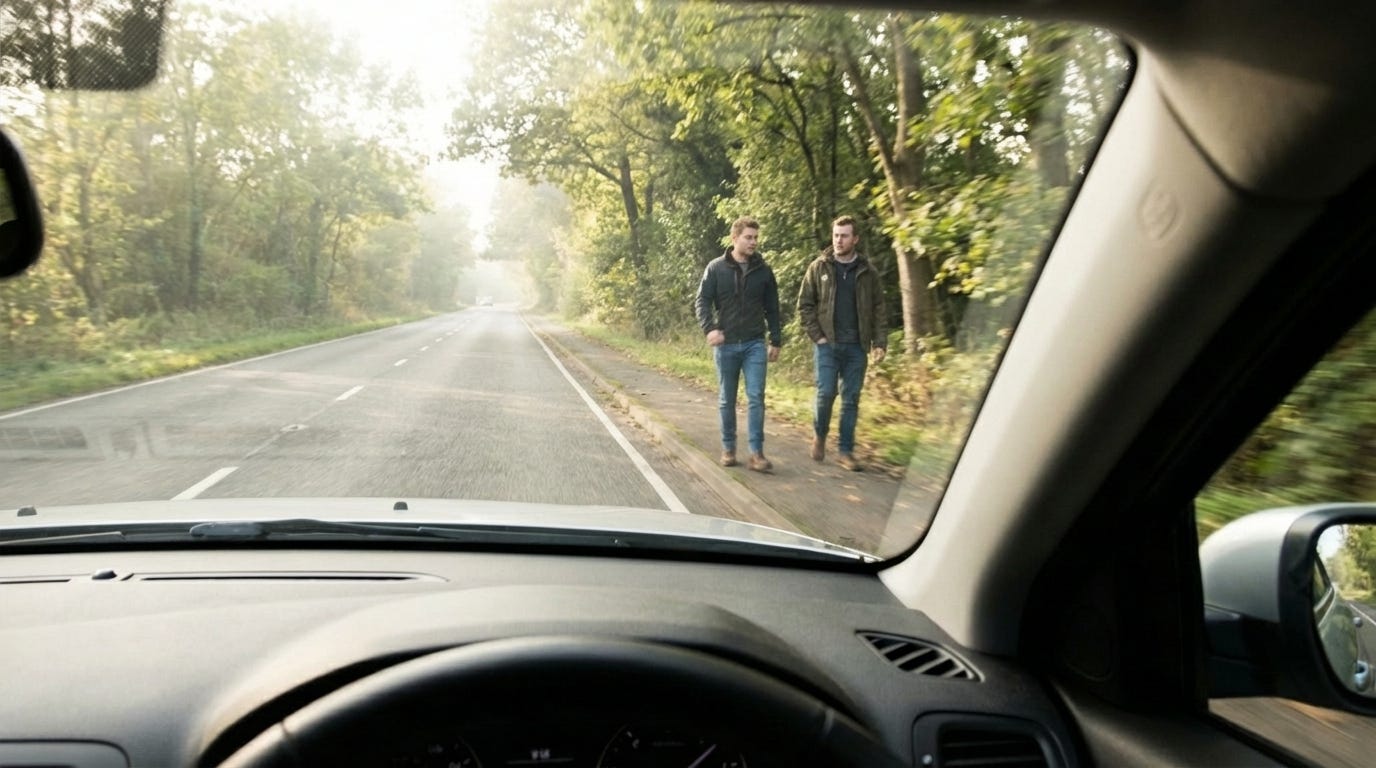
Today, on the way to church, I saw two men walking on the side of the road.
They weren’t rushing. They didn’t look like they were heading somewhere urgent. They were just walking together, slowly, like they were taking a stroll.
It hit me harder than I expected.
It was just two men walking. But the image felt strangely rare, almost foreign. And as I watched them I found myself asking: when was the last time I had taken a walk with a friend? Not to go to the shops. Not as part of exercise. Not on the way to some other thing. Just a walk. Just time together. Just movement and conversation without an agenda.
I couldn’t remember.
I’ve been sitting with that all day. Because it put words to a feeling I’ve been carrying for a while, one I didn’t quite know how to name until I saw those two men doing something so ordinary that it looked almost strange.
Every week, I meet my friends at church, people I genuinely love. But often, when we see each other, there’s this awkwardness at the start. It feels like we have to do a full life update before we can settle into each other’s company. Summarize the week. Sometimes the last two weeks. Work, family, stress, random developments, whatever happened since we last saw each other. And there’s this subtle distance underneath it all, because where do you even start?
I don’t think that awkwardness comes from a lack of love. I think it comes from a lack of overlap.
We still care about each other, but we’re no longer inside enough of each other’s ordinary lives. We know the headlines, but not the texture. We know what happened, but we weren’t there when it happened. So every reunion begins with reporting.
And I think I know why.
Everyone wants the village, but no one wants to be the villager.
The village is built out of small inconveniences
Think about something as simple as moving house.
You can hire a moving company. They arrive, they carry the boxes, they do the work, and that’s that. The problem is solved. Everyone moves on.
Or you can ask your friends to help.
If you ask your friends, you’re inconveniencing them. They have to block out a day. They have to reorder their plans around your need. They have to lift your stuff and drive home tired and dusty, feeling like they spent their Sunday afternoon in somebody else’s problem.
And yet, something richer has happened. You’ve shared an experience. There’s conversation between the boxes. There are jokes. There’s frustration. There’s pizza at the end. There’s the feeling, however ordinary, that your life touched theirs and theirs touched yours. The move is no longer just an event that happened to you. It becomes part of the story your friendship carries.
The same thing is true of something as small as a lift from the airport. I can order an Uber. It’s easy. I don’t need to ask anyone. I don’t need to impose. I don’t need to make myself someone else’s responsibility. But if a friend picks me up, there’s the catch-up in the car, the small ritual of arrival. I re-enter home not through a transaction but through a relationship.
The modern world is very good at helping us complete tasks without needing each other. That’s often a good thing. But when it becomes the default shape of life, we solve the practical problem and eliminate the relational opportunity in the same stroke. The inconvenience wasn’t a bug. It was the mechanism.
We’ve confused updates with overlap
A lot of what we call friendship now is really the exchange of updates rather than the sharing of life.
There’s a difference between knowing what happened to your friend and having some firsthand connection to the thing that happened.
There’s a difference between hearing that someone had a stressful week and having been one of the people who helped carry some part of that week.
There’s a difference between hearing about someone’s child’s football match and having stood on the sidelines with them, even though you don’t care about football.
There’s a difference between hearing that someone moved house and having been one of the people sweating through the move with them.
There’s a difference between hearing that someone got back from a trip and having been the one who picked them up from the airport.
The more life is lived in private lanes, self-managed and app-mediated, the more our relationships are forced to survive on narration. We tell each other what happened after the fact. We perform catch-up.
That’s better than nothing. But it’s not the same thing as overlap. And without overlap, relationships begin to feel strangely thin even when the affection is still real.
I think that’s the feeling I’ve been sensing at church. It’s not that my friends and I have stopped loving each other. It’s that too much of our lives now happens offstage from one another. So when we meet, we’re left trying to compress days of living into a few minutes of reporting. We’re trying to recreate in speech what might have been built through shared presence.
It’s very hard to feel deeply connected to people whose lives you only access through summaries.
Friendship needs time that has no purpose
That image of the two men walking stayed with me because it pointed to another part of the problem.
Those men weren’t solving anything. They weren’t doing a favour. They weren’t completing an errand. They were just together.
That looked rare to me because it has become rare.
We live in a world that trains us to justify our time constantly. Even our friendships become structured around events. We meet for church, for dinner, for coffee because we haven’t seen each other in a while. Always around a reason. Around an occasion.
But when do we just walk?
When do we sit around long enough for conversation to unfold without a plan?
A lot of real closeness is built in exactly the kind of time that looks wasteful to the productive mind. Slow time. Meandering time. Time with enough slack for random thoughts, dumb jokes, silences, little detours, memories that surface unexpectedly. The kind of time that doesn’t produce an obvious output but leaves you feeling like you actually know someone.
Friendship grows in the walk that had no destination. In the extra hour after the thing. In hanging around and tagging along. In being near each other without needing a reason impressive enough to justify the time.
We say we want connection, but we increasingly reserve our lives for efficiency. We still make time for each other, but often only in formats too tight, too structured, or too occasional to hold the weight of actual friendship.
So when we meet, we’re left asking, “Where do we even start?”
Prosperity makes this worse
And here’s the uncomfortable part: a lot of us are choosing this. I’m choosing this. Not consciously, not maliciously, but structurally.
As your means increase, your ability to avoid needing people increases with it. You can pay for delivery. You can hire help. You can solve privately what previous generations solved communally.
On one level, that’s a gift.
But one of the hidden temptations of having more means is that you can begin to structure your life so that you never need anyone. That looks like freedom. It looks like adulthood done properly.
If you’re not careful, it also hollows out the ordinary give-and-take from which community is built.
Our parents often relied on other people because they had to. Not because they were more enlightened. But because life forced a level of human entanglement that many of us can now pay to avoid. If you didn’t have the money, the services, the spare capacity, then you asked someone. You borrowed something. You made do through human beings.
Now many of us have enough means to opt out of all of that. And that’s the danger. The better off you are, the easier it becomes to build a life where no ordinary person ever has any real claim on your time. No one needs to be asked. No one needs to be leaned on. And if nobody is ever leaned on, nobody is ever bound.
What earlier generations practiced by constraint, we may now have to practice by conviction. Not because independence is wrong, but because unchecked independence has a way of quietly becoming isolation.
The moral vocabulary of avoidance
There’s another layer to this that I find hard to ignore, partly because I’ve felt its pull myself.
We live in a moment saturated with a certain kind of therapeutic language. Protect your peace. Set boundaries. You don’t owe anyone anything. Cut people off. Prioritize yourself. Do what’s best for you.
Some of these ideas, in the right setting, are real and important. But once they get flattened into internet slogans, they start doing something else entirely. They become a moral vocabulary for avoiding ordinary human obligation. And the scary part is how reasonable it sounds. Who would argue against protecting your peace?
Every inconvenience begins to feel suspect. Every request starts sounding like a threat to your peace. Every uncomfortable act of care begins to look like poor boundaries.
What gets lost is a simple truth: a meaningful human life involves being claimed by people. It involves caring about things that wouldn’t matter to you except that they matter to someone you love.
There’s a difference between being harmed by others and being needed by others. There’s a difference between exploitation and obligation. A healthy life has to know that difference, because once you collapse those categories, every form of community starts to feel dangerous. And once community feels dangerous, the village is finished.
What being a villager actually looks like
To be a villager is to care about what matters to your people.
It’s going to your friend’s child’s football match even though you don’t care about football. It’s helping carry things you didn’t ask to carry. It’s showing up at an inconvenient time. It’s taking a call when you were planning to rest. It’s being brought into someone else’s world and treating that not as an interruption from real life but as part of real life.
This is how community is actually built. Not in grand gestures, but in many small acts of presence over time. You make the airport run. You help with the move. You sit in the waiting room. And then, almost without noticing, your lives become intertwined. People stop being adjacent to your story and start appearing inside it.
You can no longer think about being pregnant with your first child without remembering that Dombolo threw a celebration for you. You can’t think about your 40th birthday without also thinking about the surprise party Dombolo organised that you didn’t attend. You can’t think about the time you lost your baby without remembering Nigel picking you up to take you to the airport at 7am on a winter morning. Your experiences are no longer just yours. You’ve lived life together.
That’s shared memory. It’s the reason you don’t have to do the full catch-up every time you see each other. Your friend was already there for parts of the story.
There’s a kind of adult life many of us are quietly building. I recognize it because I see it in my own. A life of smooth functioning. Bills paid. Calendar controlled. Problems resolved with minimal disruption. Nothing too dependent. Nothing too needy.
It sounds responsible. It sounds mature.
But it can also become a sealed life. A life where nobody can really enter unless invited in advance. Where needs are outsourced before they can become shared. Where convenience has protected us not only from hassle but from belonging.
A villager isn’t simply someone who likes people. A villager is someone whose life can be entered.
Take the walk
I keep coming back to those two men on the side of the road.
What struck me wasn’t just that they were together. It was that they were unhurried. Their time seemed open. Their presence with each other didn’t appear to need justification. They weren’t achieving anything. They were just sharing time.
And that image felt like a small rebuke to the way I’ve been living.
We’ve learned to value convenience so highly that we often don’t notice what it’s costing us. We protect our time so carefully that we don’t always realize we’re also protecting ourselves from one another. We avoid burdening people, and in doing so we sometimes avoid belonging to them.
But some of what looks inefficient is where life actually happens. And some of what seems like a burden is just what love looks like in ordinary clothes.
The window for many of these ordinary acts of presence is shorter than we like to think. You don’t get infinite chances to take the walk, make the trip, show up at the thing. Some of the people whose lives you could be sharing right now won’t always be this available.
Maybe the reason so many of us feel this low-grade distance from people we genuinely love isn’t that affection has disappeared. Maybe it’s that our lives are no longer arranged in ways that generate enough shared experience. Maybe the reason catch-ups feel so heavy is that they’re doing too much work. Maybe we’ve become too good at avoiding one another’s burdens.
We’re friends. We care. We mean it. But we’ve lost many of the little practices through which friendship becomes thick and natural. So we stand there doing updates. Trying to bridge with words what should have been built with life.
Everyone wants the village.
I’m starting to think the real question isn’t whether we want one. It’s whether we’re willing to live in a way that makes one. To ask for the lift instead of the Uber. To take the walk. To leave room in our lives for demands we didn’t schedule.
For my part, I think I need to take more walks.


